Skip to content

2026 Best Motorized Pallet Jack for Your Warehouse?
Choosing the 2026 Best Motorized Pallet Jack for Your Warehouse starts with the work it must do every day. A machine that glides across a smooth loading dock may struggle on cracked concrete or tight turns between crowded racks. Capacity matters, but so do travel distance, load frequency, aisle width, and operator comfort. Small details count. Handle reach. Brake response. Battery access.
Ergonomics researcher Dr. Thomas R. Waters has emphasized designing work around people’s capabilities. His research offers a useful reminder for equipment buyers: a powered jack should reduce effort without creating new control or handling problems. That is not a promise of perfect performance. No single model fits every operation.
This guide compares Motorized Pallet Jack options through practical warehouse questions: How far does each shift run? Can the jack turn safely in your narrowest aisle? Does its battery support the real duty cycle, including peak periods? We’ll also consider rated capacity, tiller controls, charging needs, maintenance access, and the surface under the wheels. A glossy specification sheet can hide an awkward fit. I learned that the hard way? More accurately, buyers often discover it only after a machine meets their busiest route. Check current manufacturer specifications, confirm compatibility with your loads and site conditions, and involve operators in testing shortlisted models. The best choice is not automatically the fastest or cheapest. It is the one that performs reliably in your warehouse, shift after shift.
What Is a Motorized Pallet Jack?
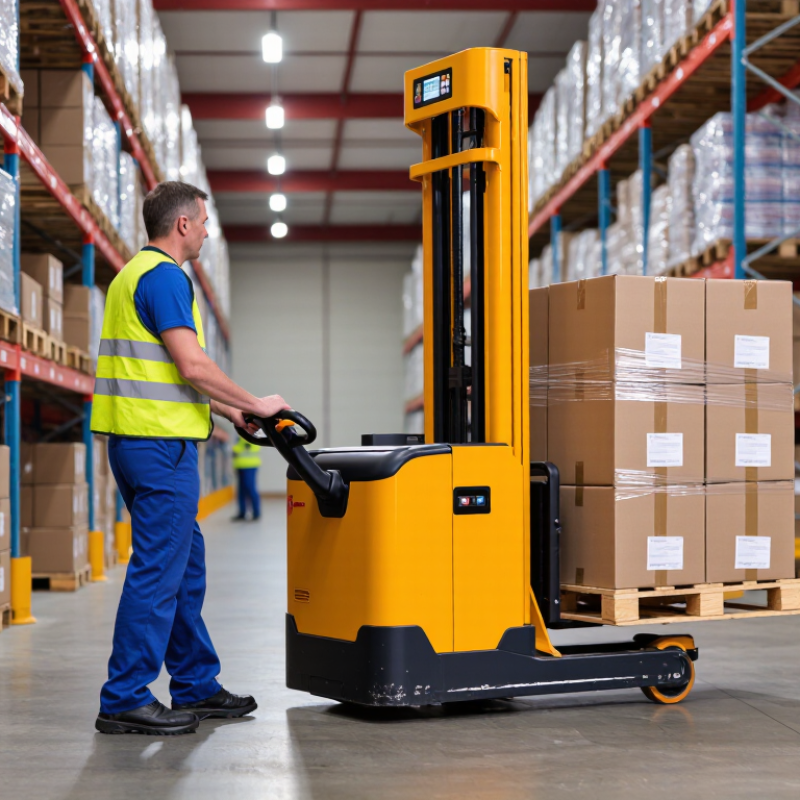
A motorized pallet jack is a powered warehouse tool that moves palletized loads across relatively short distances. An electric motor drives the wheels, while a powered lift raises the forks enough to clear the floor. The operator steers with a control handle, either walking behind the machine or riding on a platform, depending on the model. That matters. It is not simply a manual jack with a battery attached: powered travel and lifting can change how quickly a load moves, so smooth control and clear sightlines are essential.
These machines are commonly used on level warehouse floors, in loading areas, and along busy picking routes. They are generally more compact than forklifts, but they are not suited to every load or surface. Check the rated capacity, fork dimensions, turning space, and floor condition before choosing one. A damp patch or damaged pallet can make a routine move less predictable. Not a forklift. Operators should inspect the wheels, forks, horn, controls, and battery condition before use, and follow the equipment’s operating instructions. A common planning mistake is focusing only on maximum capacity. Travel distance, shift length, charging access, and narrow aisles matter too. The right choice can still feel awkward if the turning space was measured poorly.
2026 Best Motorized Pallet Jack for Your Warehouse? — What Is a Motorized Pallet Jack?
A motorized pallet jack is a powered truck that lifts and moves palletized loads. The specifications below are typical ranges for common configurations, not specifications for a particular model.
| Configuration | Typical Capacity | Typical Fork Length | Typical Battery | Best Suited For | Key Trade-Off |
|---|---|---|---|---|---|
| Compact walkie | 3,000–4,500 lb (1,360–2,040 kg) | 36–42 in (914–1,067 mm) | Typically 24 V; lead-acid or lithium-ion | Smaller warehouses, tight aisles, and short-distance pallet moves | Compact maneuverability; check pallet size and rated capacity carefully |
| Standard walkie | 4,000–6,000 lb (1,814–2,722 kg) | 42–48 in (1,067–1,219 mm) | Commonly 24 V; lead-acid or lithium-ion | General warehouse work and moderate daily pallet movement | A practical all-rounder; operator walks behind the truck |
| Walkie-rider | 5,000–8,000 lb (2,268–3,629 kg) | 42–48 in (1,067–1,219 mm) | Often 24 V or 36 V; battery type varies | Frequent moves over longer distances, with a platform for the operator | Higher throughput potential; requires more space and operator training |
| Heavy-duty walkie | 6,000–8,000 lb (2,722–3,629 kg) | 42–48 in (1,067–1,219 mm) | Typically 24 V or higher; check battery capacity and duty cycle | Heavier loads and demanding applications within the truck’s rated limits | Greater load capability may mean a larger truck and wider turning needs |
| Selection Check | What to Verify |
|---|---|
| Load and pallet fit | Match the truck’s rated capacity to the heaviest load; confirm fork length, fork spacing, and pallet entry direction. |
| Aisles and turning | Measure aisle width, turning space, dock plates, and doorways against the specific truck’s dimensions and turning radius. |
| Shift and charging needs | Compare expected operating hours and charging access. Lithium-ion batteries generally support opportunity charging; follow the battery and charger instructions. |
| Floor and environment | Check floor condition, ramps, thresholds, temperature, and required tires. Use only within the truck’s rated gradeability and operating limits. |
Specifications vary by design and configuration. Confirm the capacity plate, dimensions, battery requirements, and operating limits for the exact truck before purchase or use.
Related Posts
-
Comprehensive Guide to Best Electric Pallet Jack Specifications and Operational Tips
-
Exploring the Future of Best Pallet Trucks in the 2025 Market Landscape
-
How to Choose the Right Motorized Pallet Jack for Your Business Needs
-
8 Reasons Why a Powered Pallet Jack Is Essential for Efficient Warehouse Operations
-
What Makes the Best Powered Pallet Jack Stand Out in Material Handling
-
2026 Best Powered Pallet Jack Options for Your Warehouse Needs?
Our
Brands