2026 Best Engine Cylinder Block Suppliers for Global Buyers
Choosing an Engine Cylinder Block supplier in 2026 requires more than comparing unit prices. Buyers must assess casting consistency, machining capability, material traceability, and delivery resilience. A small flaw near a coolant passage can become a costly production problem. Details matter.
Industry data shows why supplier decisions remain complex. OICA reported approximately 92.5 million motor vehicles produced worldwide in 2024. Meanwhile, the International Energy Agency’s Global EV Outlook 2025 reported more than 17 million electric car sales that year. These figures describe a shifting market, not a simple end to combustion engines. Hybrid vehicles and replacement demand still require dependable engine components, while regional production needs differ.
The block itself carries demanding engineering responsibilities. It must manage heat, support crankshaft loads, preserve cylinder geometry, and withstand repeated pressure cycles. Paraphrasing the system-level engine research of John B. Heywood, an MIT professor and combustion-engine authority, a block should be evaluated as part of the complete engine, not as a casting alone. That distinction matters when comparing suppliers.
This guide examines global suppliers through practical buyer criteria: process control, casting materials, machining tolerances, inspection records, customization, and shipment reliability. Buyers should request evidence, including inspection plans and sample measurement reports, rather than relying on broad quality claims. A polished brochure is not proof. Supplier rankings also have limits; capabilities can vary by plant, program, and production volume. The strongest choice is the supplier whose verified processes match the engine design, sourcing region, and long-term service needs.
Engine Cylinder Blocks: Types, Materials, and Core Functions
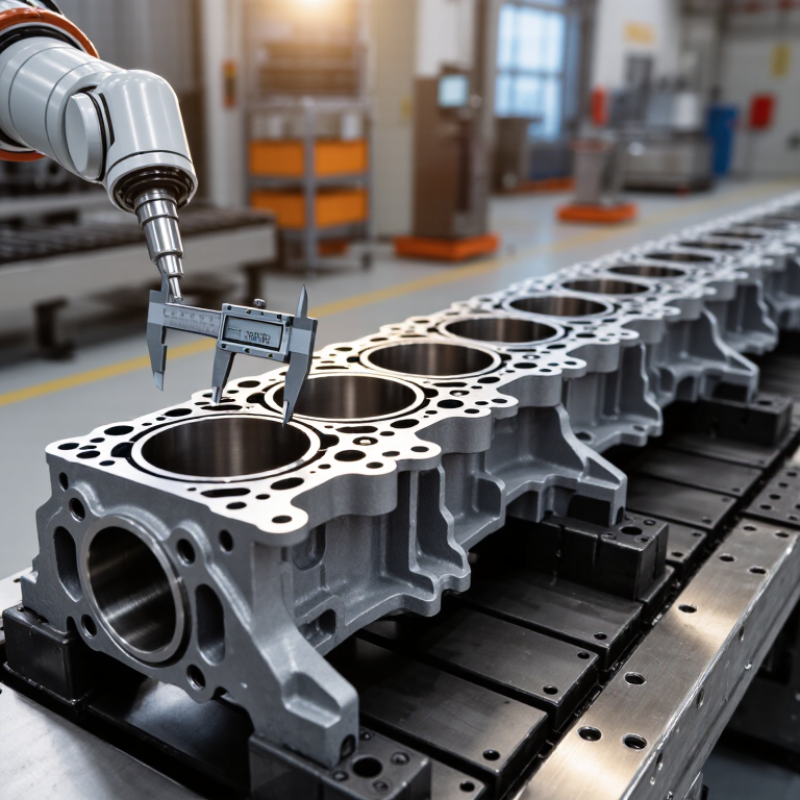
Engine cylinder blocks come in several layouts, including inline, V-shaped, and horizontally opposed designs. The layout determines how cylinders sit around the crankshaft and affects engine width, height, and packaging. Blocks may also use open-deck or closed-deck structures. Open decks leave more space around the cylinder tops for coolant flow; closed decks provide more support near the head gasket. Neither design is ideal for every duty cycle.
Material choice shapes weight, heat handling, and service life. Cast iron is rigid and wear-resistant, but adds mass. Aluminum alloy reduces weight and moves heat efficiently, though cylinder surfaces often need liners or durable coatings. Compacted graphite iron offers a balance of strength and weight in some demanding applications. Details matter. A block’s passages, wall thickness, and machining quality can matter as much as its base material.
The block anchors the crankshaft, supports the cylinders, and contains routes for engine oil and coolant. It also helps keep moving parts aligned under combustion pressure and temperature changes. During inspection, technicians may check deck flatness, bore wear, cracks, and corrosion around coolant passages. A lighter block is not automatically better. Selection depends on load, cooling, repair needs, and the vehicle’s operating conditions. Even careful specifications can miss real-world wear patterns. That deserves a second look.
Engine Cylinder Block Materials: Typical Density
Representative densities are approximately 2.7 g/cm³ for aluminum alloy, 7.1 g/cm³ for compacted graphite iron, and 7.2 g/cm³ for gray cast iron. Actual values vary by alloy and grade. Aluminum can reduce block mass, while iron materials are commonly selected for their strength and wear resistance.
How the Global Supplier Market Is Structured in 2026
The global engine cylinder block supplier market is organized around foundry capability, machining depth, and proximity to vehicle assembly plants. OICA reported approximately 92.5 million motor vehicles produced worldwide in 2024, sustaining demand across established and emerging manufacturing regions. Suppliers therefore range from local casting specialists to larger Tier 1 manufacturers that deliver machined blocks and coordinate component integration. The boundary is not always clean.
Material choices shape the supplier landscape. Aluminum blocks support lower vehicle weight, while cast iron remains relevant where durability, cost, and established engine designs matter. A supplier’s real capability is visible in the details: casting porosity controls, machining tolerances, traceable inspection records, and stable delivery schedules. These factors can matter more than headline capacity. Not quite simple.
Electrification is also changing the market’s long-term shape. The International Energy Agency’s Global EV Outlook 2025 reports that electric car sales exceeded 17 million in 2024, or more than one in five new cars sold. That trend may reduce future demand for some engine blocks, but regional timelines differ. Buyers should assess tooling life, engineering support, and realistic production forecasts—not just quoted unit prices. Supplier categories overlap, and public market data rarely separates cylinder blocks cleanly from broader engine or casting segments. A careful comparison still takes work.
Key Criteria for Evaluating Cylinder Block Suppliers
A cylinder block supplier should be judged by process control, not polished sales claims. Ask how casting composition, heat treatment, and machining are monitored for each production lot. Request material certificates, dimensional inspection reports, and records of porosity or pressure testing. Small details matter. Oil galleries and coolant passages should be checked, not merely the visible surfaces.
Compare inspection results with your drawing’s specified tolerances. A capable supplier can explain measuring methods, calibration intervals, and how rejected parts are handled. Review a sample block for bore finish, deck flatness, and cleanly machined threads. Then check whether the supplier can repeat those results at your required volume. One attractive sample proves little. Records should match. Still, paperwork alone cannot reveal every production weakness.
Lead time, tooling ownership, packaging, and technical communication also affect supply reliability. Ask for realistic capacity data and a clear process for engineering changes. For overseas shipments, confirm protective packing against moisture and impact, plus consistent part identification across cartons and documents. Do not assume every supplier interprets drawings the same way; clarify datums, inspection points, and revision control in writing. A useful evaluation leaves room for doubt: audit evidence, compare samples, and revisit assumptions before committing.
Comparing Manufacturing Capabilities, Quality, and Certifications
2026 Best Engine Cylinder Block Suppliers for Global Buyers
Comparing Manufacturing Capabilities, Quality, and Certifications
A capable cylinder block supplier should show how it controls casting, machining, and inspection—not just finished-part photos. Ask for process details: alloy specifications, heat-treatment records, and documented controls for porosity. For machined blocks, review bore diameter, roundness, deck flatness, and measurement methods. A coordinate-measuring machine report is useful, but request the actual readings and tolerances. That matters.
Certifications help assess a supplier’s quality system, but they do not certify every block. ISO’s 2022 Survey of Management System Standard Certifications recorded 1,265,216 valid ISO 9001 certificates across 190 countries. Buyers should verify the certificate’s scope, site, and validity, then compare it with part-level evidence such as pressure-test results and material traceability. A polished audit file can still leave gaps in daily production control; that deserves scrutiny.
Tips: Request a sample inspection report, a control plan, and a clear explanation of how defects are contained. Compare quoted tolerances with your drawing, and confirm who approves changes to tooling or process settings. If possible, review a production sample under the same inspection plan used for regular shipments. One overlooked detail can matter.
 Skip to content