What Is a PCB Conveyor and How Does It Work?
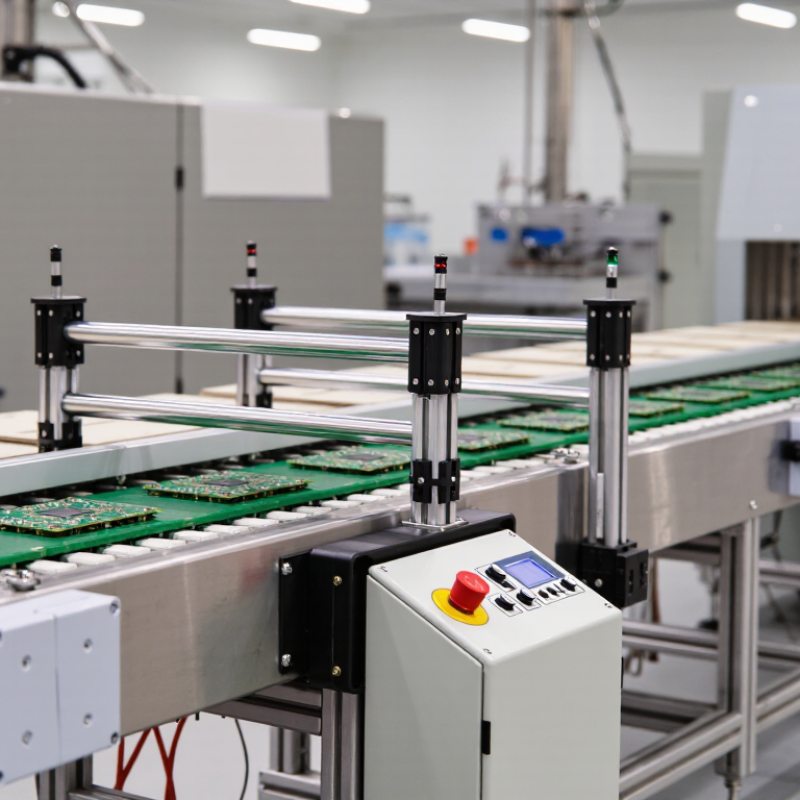
A printed circuit board rarely moves through an assembly line by hand. It travels between machines, where placement, inspection, and reflow steps must stay coordinated. A Pcb Conveyor is the transfer equipment that carries boards between these stations. It usually combines adjustable side rails, a belt or chain drive, sensors, and controls that communicate with neighboring machines.
The process is straightforward, but its details matter. A board enters on one side, pauses at a sensor, and advances when the next station is ready. Some conveyors also include buffer zones or lift gates, helping operators manage machine changes and access. A few millimeters of rail misalignment can cause a board to skew or stop. That is easy to overlook.
The wider electronics market helps explain why dependable handling matters. In its Fall 2024 Semiconductor Market Forecast, the World Semiconductor Trade Statistics (WSTS) organization projected global semiconductor sales of $627.6 billion for 2024 and $697.2 billion for 2025. These figures describe semiconductor sales, not PCB conveyor shipments, so they should not be mistaken for direct conveyor-market data. Still, they signal the scale of electronics production that assembly lines support.
This guide explains what a Pcb Conveyor does, how its sensors and transfer controls work, and where common conveyor types fit in a surface-mount technology line. Real lines vary. A standard setup may still need careful adjustment for board width, component clearance, and machine timing.
What a PCB Conveyor Is and Its Role in Electronics Manufacturing
A PCB conveyor is a controlled transfer unit that moves printed circuit boards between stations on a surface-mount technology line. It typically uses parallel rails, adjustable width, and a motor-driven belt or chain. At the line entrance, a board arrives from a loader; sensors detect its position, then the conveyor advances it to a printer, placement machine, or reflow oven. The handoff must be gentle and repeatable. A small rail mismatch can skew a panel, while poor speed coordination can create gaps or collisions. Small details matter.
The conveyor’s role is not merely transport. It helps maintain line flow, board orientation, and spacing, and can provide a buffer when neighboring machines run at different rates. The International Federation of Robotics’ World Robotics 2024 report recorded 4.28 million industrial robots operating worldwide in 2023, reflecting the wider shift toward factory automation. A conveyor is simpler than a robot, but it supports the same practical goal: consistent movement with less manual handling. Still, more automation is not always better. A poorly tuned conveyor can pass defects downstream faster, and operators still need access for inspection and changeovers. In real production, rail width, transfer height, board weight, and signal compatibility should be checked against every connected machine. A rushed setup can look fine, until the first narrow panel slips.
What Is a PCB Conveyor and How Does It Work?
Typical PCB flow through an SMT assembly line
A PCB conveyor transfers circuit boards between production machines and helps maintain a continuous line flow. The chart shows the typical process order; it is a schematic, not a measurement of time or throughput.
The Main Components of a PCB Conveyor
A PCB conveyor moves boards between assembly stations while keeping them supported and aligned. Its frame carries adjustable guide rails, which operators set to match board width. Side rails should hold the PCB securely without pressing components or scraping its edges. Alignment matters. A belt or chain moves the board; a motor and speed controller regulate its travel. Rollers support the underside, but their spacing must suit the board and its weight. Thin boards can sag. That detail is easy to miss.
Sensors detect a board at the infeed or transfer point, while a stopper can pause it for inspection or processing. The control system coordinates these actions with neighboring equipment. International Federation of Robotics’ World Robotics 2024 report counted 4,281,585 industrial robots operating worldwide in 2023, a 10% increase from 2022. That broad automation figure helps explain why predictable conveyor handoffs matter, though it does not measure PCB conveyor performance directly. Not just rollers.
For stable transfers, check conveyor height, rail width, belt tension, and sensor position during setup. A small height mismatch can catch a board’s edge between machines. ESD-safe surfaces and proper grounding also help limit electrostatic risk around sensitive assemblies. The exact configuration varies by line, and there is no universal setting: board thickness, component clearance, and required speed all affect the choice. I would treat rail adjustment as a process check, not a one-time setup task.
How a PCB Conveyor Moves Boards Through an Assembly Line
A PCB conveyor links stations on an assembly line and moves circuit boards between them. Adjustable side rails hold each board by its edges, while belts or narrow chains carry it forward. The rails must match the board width. Too much clearance can let a board shift; too little can press against its edges. Small details matter.
As a board approaches the conveyor’s end, a sensor detects it and signals the stopping mechanism. The board pauses at a transfer point until the next machine is ready. Then the stop gate releases it, and the next conveyor or process accepts the board. This handoff may connect a printer, placement machine, reflow oven, or inspection station. Timing signals help prevent boards from crowding or colliding. A smooth transfer is the goal.
Operators adjust conveyor width when changing board sizes and check that rails remain parallel. They also watch for uneven movement, loose debris, or boards that stop short. These checks sound simple. They are easy to overlook during a busy shift. In practice, transfers are not always perfectly smooth; a slightly warped board or poorly aligned rail can interrupt flow. Conveyor settings therefore need to suit the actual board, not just the nominal dimensions.
Common PCB Conveyor Types and Their Differences
A PCB conveyor moves boards between inspection, printing, placement, and reflow stations while keeping them aligned. Common types include belt, roller, and chain or edge-support conveyors. Belt systems provide steady support beneath the board, making them useful for light assemblies. Roller conveyors suit simple transfers, but small boards may need careful guidance. Edge-support systems grip the board’s sides, leaving the underside accessible for inspection or handling.
Fortune Business Insights estimated the global PCB market at USD 81.46 billion in 2023. That figure describes the market, not conveyor demand, but it shows the scale of production these systems serve. Line-link conveyors can also include buffers or inspection stops. A buffer helps absorb brief pauses between machines; it cannot fix a persistent speed mismatch. Fit matters. The best choice depends on board size, weight, edge clearance, and the process at each station—not just line speed.
Tips: Check rail width and transfer height with a real board, not only a drawing. Confirm sensor placement, smooth starts, and ESD grounding. Keep the first test modest: a fast conveyor can still cause jams if boards arrive unevenly. One detail is easy to overlook—the clearance needed for components beneath the board.
Where PCB Conveyors Are Used in the Production Process
A PCB conveyor is used wherever boards must move between production stations without being handled by hand. In a surface-mount line, it commonly links solder-paste printing, inspection, component placement, reflow soldering, and final optical inspection. Adjustable side rails guide each panel; sensors and stop gates control spacing. Small buffers can hold boards briefly when one machine runs slower than the next. A reject lane may divert a board for review.
The scale is substantial: Prismark’s 2024 analysis, reported by IPC, estimated global PCB production value at about $73.4 billion in 2023. Conveyors help keep these high-volume lines moving, but they do not guarantee quality. A misaligned rail can scrape a panel edge. A poorly balanced line can turn a buffer into a bottleneck. Details matter.
Conveyors also connect inspection, cooling, and board-loading stations, especially where operators need predictable access to panels. The International Federation of Robotics reported 4,281,585 industrial robots operating worldwide in 2023, up 10% from the prior year. That figure signals broader factory automation, not conveyor adoption specifically. In practice, conveyor speed, panel width, and transfer height must match the machines around them. A setting that works for one board size may not suit another.
 Skip to content