2026 Top Clamp On Water Meter Types for Global Buyers
Water losses are becoming a measurable business risk, not merely a maintenance concern. The WHO and UNICEF Joint Monitoring Programme reported that 2.2 billion people lacked safely managed drinking water services in 2022. Meanwhile, the United Nations World Water Development Report 2024 states that agriculture represents about 70% of global freshwater withdrawals. These figures make accurate distribution monitoring increasingly important for utilities, industrial plants, and commercial facilities.
A Clamp On Water Meter measures flow from outside the pipe, usually through ultrasonic sensors fixed around its exterior. This design avoids pipe cutting, service shutdowns, and many contamination risks during installation. For global buyers, available types include transit-time ultrasonic meters, Doppler ultrasonic meters, portable verification units, and battery-powered or fixed monitoring systems. Each type suits different conditions. Clean water favors transit-time measurement, while suspended particles may support Doppler operation. Pipe material, diameter, wall thickness, lining, temperature, and flow profile still influence accuracy.
Small errors matter. A poorly positioned sensor can produce convincing but unreliable readings. ISO 4064 and AWWA guidance provide useful references for meter performance, installation, and verification. The U.S. Environmental Protection Agency also emphasizes improved water-system efficiency through monitoring and asset management. However, specifications alone cannot guarantee field results. Real pipelines contain rust, air pockets, vibration, and changing flow rates. That is where buyer judgment becomes essential. This 2026 guide compares major Clamp On Water Meter types, practical applications, accuracy considerations, and procurement details. It also questions one common assumption: the most advanced meter is not always the most suitable meter. Reliability often begins with correct installation and honest operating data.
What Clamp-On Water Meters Are and How They Work
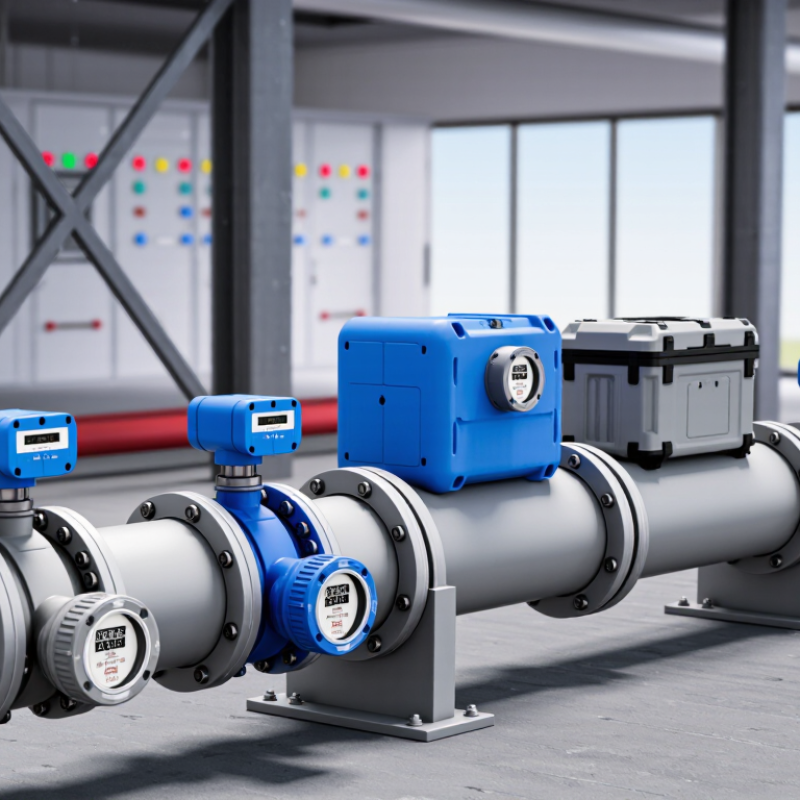
Clamp-on water meters measure flow without cutting the pipe or interrupting service. Sensors attach to the outer wall with straps, chains, or magnetic fixtures. This makes them useful for municipal lines, industrial systems, and temporary surveys.
The most common type uses ultrasonic transit-time technology. Two transducers send sound pulses through the water, both downstream and upstream. The downstream pulse usually travels slightly faster. The meter converts this time difference into flow velocity, then calculates volume using the pipe diameter.
Doppler meters work differently. They reflect ultrasonic signals from suspended particles or small air bubbles. They need water with enough internal movement to create a reliable return signal.
Installation affects the reading more than many buyers expect. A technician should confirm the pipe material, wall thickness, outside diameter, and sensor spacing. Clean metal contact matters. Coupling gel fills tiny gaps between the sensor and pipe surface. Straight pipe sections usually provide steadier results than elbows or valves nearby. That distinction matters.
Transit-time meters often suit cleaner water. Doppler units can perform better in wastewater or particle-rich flows. Portable models support audits, while fixed meters provide continuous monitoring.
Yet the method is not magic. Rust, scale, trapped air, partially filled pipes, and incorrect pipe data can distort results. The setup may look correct and still mislead. Repeating the measurement at another pipe location is a practical check. Recording temperature and mounting conditions also improves later review.
Key Clamp-On Water Meter Types for Different Applications
Transit-time ultrasonic clamp-on meters suit clean water in municipal mains, commercial buildings, and process lines. They measure the travel-time difference between two sensors mounted outside the pipe. This avoids shutdowns, cutting, and wetted components. For larger pipes, multi-path versions can improve flow-profile compensation, although poor sensor alignment still creates errors.
Doppler ultrasonic meters are better for wastewater, irrigation return flows, and water containing suspended solids or air bubbles. They need particles to reflect the signal. Clean water can produce weak readings. Portable clamp-on units support leak surveys, temporary audits, and commissioning checks, while fixed units provide continuous data for district metering and pump monitoring.
A practical choice depends on pipe material, diameter, wall thickness, lining, flow range, and water quality—not only price.
The 2024 UN World Water Development Report states that agriculture represents about 70% of global freshwater withdrawals. This makes reliable irrigation measurement especially important. The WHO/UNICEF Joint Monitoring Programme reported that 2.2 billion people lacked safely managed drinking water in 2022, increasing pressure to reduce distribution losses.
Field experience shows that installation quality can matter as much as meter type. Rust, scale, or an inaccurate pipe diameter can distort results. That detail is easy to overlook. Measurement plans should include site verification, signal-strength checks, and periodic comparison with a trusted reference meter.
How Measurement Methods Affect Meter Selection
2026 Top Clamp On Water Meter Types for Global Buyers
How Measurement Methods Affect Meter Selection
Clamp-on water meters are not interchangeable tools. Their measurement method must match the water and pipe conditions. Transit-time ultrasonic meters compare upstream and downstream signal travel times. They usually suit clean water, full pipes, and stable flow. Doppler meters use reflections from suspended particles or air bubbles. They perform better in wastewater or water with visible solids, but readings may drift when particle levels change.
The choice matters beyond technical accuracy. The WHO and UNICEF Joint Monitoring Programme reported that 2.2 billion people lacked safely managed drinking water in 2022. Better flow data can expose distribution losses and support maintenance decisions. The World Bank has also reported that non-revenue water averages around 30% globally, although local conditions vary sharply. Measurement quality becomes a financial issue.
A practical site check should examine pipe material, diameter, wall thickness, lining, temperature, and flow profile. A straight pipe run helps. So does a full pipe.
Field experience shows a common mistake: selecting by pipe size alone. A large steel pipe carrying clean water may need transit-time measurement, while a smaller line with air entrainment may require another approach. Hybrid meters can improve flexibility, yet they are not automatically better. Installation conditions remain decisive. Even careful technicians can misread unstable flow, so a short verification test should precede permanent monitoring.
How Measurement Methods Affect Clamp-On Water Meter Selection
Transit-time ultrasonic meters are generally preferred for clean, homogeneous water because they compare upstream and downstream sound travel times. Doppler ultrasonic meters are generally better suited to water containing suspended solids or entrained air because particles or bubbles reflect the ultrasonic signal. Both methods normally require a completely filled pipe, while bidirectional measurement is available when supported by the selected instrument and installation.
Important Specifications for Global Buyers to Compare
2026 Top Clamp On Water Meter Types for Global Buyers
Important Specifications for Global Buyers to Compare
Clamp-on water meters commonly use ultrasonic transit-time or Doppler technology. Transit-time models suit cleaner water and usually provide stable accuracy. Doppler models need suspended particles or air bubbles to reflect signals. Choosing by price alone can create unreliable readings.
Pipe access matters. Compare the supported diameter range, pipe material, wall thickness, lining, and outside surface condition. Concrete, rust, paint, and uneven coatings can weaken the signal. During field checks, technicians should measure pipe dimensions directly rather than trust old drawings. A small error can shift the transducer position and affect performance.
Check accuracy, repeatability, flow range, and low-flow sensitivity under real operating conditions. Also review temperature and pressure limits, enclosure protection, display language, battery life, and available outputs. Pulse, relay, analog, and digital communication options may suit different control systems. Confirm whether the meter supports data logging and time-stamped records. Calibration documentation should identify test conditions and traceable equipment. Read the fine print. Some advertised accuracy figures apply only to ideal pipes, steady flow, and careful installation. That is not always realistic. Buyers should request installation guides, verification methods, spare sensor availability, and technical support for the destination region. Power standards and communication compatibility also deserve a practical check before ordering.
Installation, Standards, and Maintenance Requirements by Region
Clamp-on water meters usually use transit-time ultrasonic sensing, Doppler sensing, or a hybrid design. Transit-time models suit cleaner water and stable pipe conditions. Doppler models tolerate suspended particles and air bubbles better. Real sites are rarely perfect. Rust, scale, poor coupling, and unknown pipe linings can reduce accuracy.
Installation rules differ by region. In Europe, buyers should check EN ISO 4064 and the Measuring Instruments Directive when readings support commercial billing. In North America, potable-water projects commonly review AWWA guidance and NSF/ANSI/CAN 61 material requirements. Australia and New Zealand projects may also require AS/NZS 4020 contact compliance. Local authorities can add stricter verification rules. Do not assume one certificate works everywhere.
Straight pipe distance matters. Keep sensors away from pumps, elbows, valves, and partially filled sections. Record pipe material, diameter, wall thickness, liner, and water temperature before calibration. The World Bank estimated that utilities lose 48 billion cubic meters of water annually through non-revenue water. Better temporary measurement can expose hidden losses, but it cannot repair them. The 2024 UN World Water Development Report notes that agriculture uses about 70% of global freshwater withdrawals, increasing pressure on reliable monitoring.
Maintenance should include quarterly visual checks, cable inspections, signal-quality reviews, and sensor repositioning after pipe work. Clean the contact surface and renew coupling gel when readings drift. A stable display is not proof of accuracy. Independent comparison with a verified meter remains wise, especially before regional compliance testing.
 Skip to content