Skip to content
Where to Buy China Best Used Measurement Devices?
Buying reliable Used Measurement Devices in China requires more than comparing prices and product photos. A polished listing may hide worn connectors, expired calibration, missing accessories, or uncertain repair history. The best choice depends on technical condition, measurement accuracy, documentation, and the seller’s ability to answer precise questions.
Lord Kelvin, a foundational measurement authority, famously said, “When you can measure what you are speaking about, and express it in numbers, you know something about it.” His principle remains practical today. Ask for serial numbers, calibration dates, test reports, firmware versions, and clear images of ports and displays. Request actual operating evidence, not only a factory photograph. A reputable supplier should explain each device’s previous use and disclose visible defects.
Experience also teaches caution. The cheapest unit may become the most expensive after shipping, calibration, and replacement parts. That happens. Buyers should compare total ownership cost, warranty terms, return procedures, and technical support before payment. Independent calibration can strengthen confidence, especially for laboratory, industrial, and quality-control applications. However, calibration alone cannot repair internal damage or guarantee long-term stability.
This guide examines where to buy China’s best Used Measurement Devices and how to judge suppliers with professional discipline. It considers established marketplaces, specialized resellers, manufacturer channels, and direct factory contacts. No checklist removes every risk. Still, careful verification turns a speculative purchase into a defensible business decision. Reliable equipment begins with reliable evidence.
Define China’s Used Measurement-Device Market by Category and Application
China’s used measurement-device market is best understood by category and application, not by price alone. Public reports rarely isolate used units, so estimates require careful triangulation. Grand View Research valued the global test and measurement equipment market at about USD 33 billion in 2023. MarketsandMarkets projects continued growth through 2029. These figures include new equipment, but they indicate strong replacement demand in China.
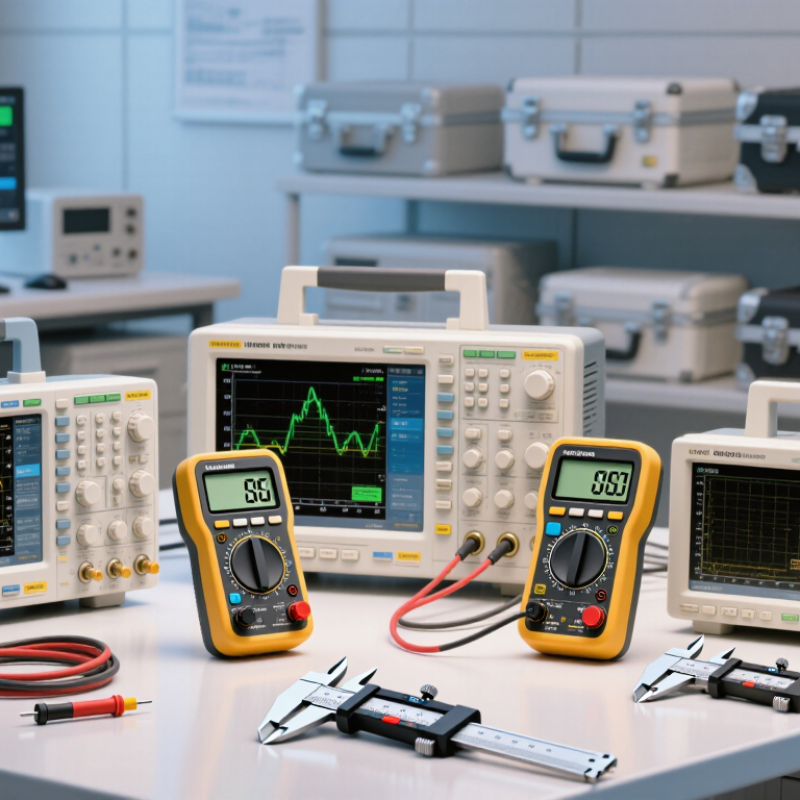
For electronics repair and production, oscilloscopes, spectrum analyzers, signal generators, and digital multimeters remain practical choices. Telecommunications buyers often seek frequency-analysis equipment with traceable calibration records. Automotive workshops favor diagnostic, battery-testing, and power-analysis instruments. Universities and smaller laboratories usually purchase general-purpose devices because budgets are tighter. Environmental testing systems serve materials, electronics, and manufacturing applications, but their resale prices vary sharply with chamber condition.
The best purchasing channels are specialized refurbishers, industrial resellers, laboratory closures, and verified equipment auctions. Ask for serial records, operating-hour data, calibration certificates, and high-resolution photos of displays and connectors. A clean exterior proves little. Functional testing matters more. Buyers should compare specifications, firmware status, measurement uncertainty, and local service availability. Used equipment is not automatically economical. Missing probes, outdated software, or unstable readings can erase the savings. I would also question any listing with unusually precise performance claims but no test report. That warning is easy to ignore. It should not be. Sources: Grand View Research, Test and Measurement Equipment Market Report, 2024; MarketsandMarkets, Test and Measurement Equipment Market Report, 2024.
Where to Buy China Best Used Measurement Devices? - Define China’s Used Measurement-Device Market by Category and Application
| Category | Typical Device Type | Common Measurement Range | Typical Accuracy | Main Applications | Typical Used Price (USD) | Recommended Buying Checks |
|---|---|---|---|---|---|---|
| Electrical and Electronic | Digital multimeter | DC/AC voltage, current, resistance, frequency, and continuity | Approximately ±0.02% to ±1.0% of reading, depending on function | Electrical maintenance, production testing, laboratory troubleshooting, and field service | $20–$1,500 | Check display, input protection, test leads, battery compartment, current ranges, and calibration status |
| Electrical and Electronic | Oscilloscope | Typically 50 MHz–1 GHz bandwidth; 2–8 input channels | Vertical accuracy commonly around ±2% to ±4% | Power electronics, embedded systems, signal analysis, communications, and repair | $150–$8,000 | Verify bandwidth, sampling rate, channel operation, trigger stability, probes, fan noise, and screen condition |
| Electrical and Electronic | DC power supply | Commonly 0–30 V and 0–5 A per output; higher-power versions available | Voltage regulation commonly ±0.01% to ±0.1% | Prototype development, battery testing, production lines, and laboratory experiments | $50–$2,500 | Test voltage and current under load, output ripple, protection functions, cooling system, and terminal condition |
| Dimensional | Coordinate measuring machine | Working envelopes commonly from 300 × 300 × 200 mm to over 1,000 × 2,000 × 800 mm | Volumetric accuracy commonly 2–10 µm, depending on size and configuration | Automotive components, aerospace parts, molds, precision machining, and quality inspection | $10,000–$150,000+ | Inspect guideways, probe system, controller compatibility, software license, installation, and calibration certificate |
| Dimensional | Optical measurement system | Typical field of view from 50 × 50 mm to 500 × 500 mm | Approximately 1–10 µm, depending on optics, scale, and lighting | Small-part inspection, electronics, stamping, plastics, and tool-room measurement | $3,000–$60,000 | Check camera resolution, lens condition, stage movement, lighting uniformity, software activation, and scale calibration |
| Temperature | Temperature calibrator or dry-block calibrator | Common ranges include −30°C to 650°C; high-temperature units may exceed 1,000°C | Stability commonly ±0.05°C to ±0.5°C | Sensor verification, process maintenance, food processing, pharmaceuticals, and laboratories | $800–$12,000 | Confirm heating and cooling performance, insert size, sensor input, uniformity, and recent temperature calibration |
| Pressure | Digital pressure calibrator | Ranges from vacuum and low pressure to several hundred bar | Commonly ±0.025% to ±0.1% of full scale | Hydraulics, pneumatics, process control, energy systems, and instrument maintenance | $500–$10,000 | Check pressure ports, leakage, reference sensor, pump operation, overpressure history, and calibration documentation |
| Flow | Flow meter or flow calibrator | Gas and liquid ranges vary widely; laboratory units commonly cover low flow to tens of L/min | Approximately ±0.5% to ±2% of reading for many industrial instruments | HVAC, semiconductor processes, water treatment, gas systems, and chemical production | $300–$25,000 | Verify media compatibility, flow direction, seals, sensor response, totalizer function, and traceable calibration |
| Optical and Photonic | Optical power meter and light source | Optical wavelengths commonly 850–1,625 nm; power from nanowatt to milliwatt levels | Typically ±3% to ±10%, depending on wavelength and power level | Fiber-optic installation, telecommunications, data centers, and optical component testing | $100–$8,000 | Check detector type, wavelength calibration, connector adapters, battery life, display, and measurement repeatability |
| Materials Testing | Universal testing machine | Typical capacities from 1 kN to 1,000 kN | Force accuracy commonly ±0.5% to ±1% of indicated load | Tensile, compression, peel, flexural, and elongation testing of metals, plastics, and composites | $4,000–$80,000 | Inspect load cell, grips, crosshead movement, emergency stop, software, frame alignment, and force verification |
| Environmental | Humidity and temperature data logger | Commonly 0–100% RH and −40°C to 85°C | Humidity commonly ±2% to ±5% RH; temperature commonly ±0.2°C to ±0.5°C | Warehousing, cold-chain logistics, museums, building management, and laboratory monitoring | $20–$1,500 | Check sensor drift, memory capacity, communication interface, battery, software compatibility, and calibration record |
| Environmental | Air-quality or gas detector | Gas-specific ranges; many portable units measure ppm or %LEL | Commonly ±5% to ±10% of reading or full scale | Industrial hygiene, workplace safety, emissions monitoring, and confined-space inspection | $100–$6,000 | Confirm sensor service life, bump-test results, alarm operation, pump condition, battery health, and gas calibration |
Our
Brands