Who Are the Top Scissor Lift Manufacturers in China?
Choosing a Scissor Lift manufacturer in China takes more than comparing catalog prices. Buyers need to examine load ratings, platform dimensions, battery options, parts access, and service support. A lift may look identical in a product photo, yet differ in weld quality, controls, or maintenance documentation.
Grand View Research estimated the global aerial work platform market at approximately USD 18.2 billion in 2023 and projected continued growth through 2030. This figure covers aerial work platforms broadly, not scissor lifts alone, so it should not be treated as a China-specific market measure. Still, it reflects expanding demand for equipment used in warehouses, factories, and construction sites. Check the report’s scope before using its figures to compare suppliers.
Details matter.
This guide will compare Chinese manufacturers through practical criteria: product range, quality systems, export experience, customization, and after-sales support. It will also distinguish documented claims from marketing language. A polished brochure is not proof of reliable field performance; request technical files, references, and service terms. One limitation remains: no source articles or verifiable expert quotation were provided with this request. Rather than invent a specialist’s name or words, this introduction avoids presenting an unsupported quote. A sourced expert statement can be added once a traceable interview, report, or publication is available.
How Scissor Lift Manufacturing Developed in China
China’s scissor lift industry grew alongside demand from construction, warehouses, and building maintenance. Earlier, many buyers relied on imported machines and components. That changed gradually. Domestic manufacturers developed capabilities in steel fabrication, hydraulic assembly, electrical controls, and complete machine production. Local supplier networks also made it easier to source frames, cylinders, and wiring closer to assembly plants.
The work is hands-on. Technicians check welds, platform movement, and emergency lowering before equipment leaves the factory. As production expanded, manufacturers also adapted designs for different floor conditions, working heights, and transport needs. Growth has not been perfectly even. A large production line does not automatically ensure consistent finishing, documentation, or after-sales support. Buyers still benefit from checking rated capacity, platform extension, control response, and access to replacement parts. These practical details reveal how manufacturing has matured beyond simply building more machines.
Criteria for Identifying Leading Chinese Manufacturers
A leading Chinese scissor-lift manufacturer should prove its engineering claims with test records, not polished catalogue images. Check platform capacity, working height, gradeability, and indoor or outdoor ratings against your actual site conditions. Ask for stability and load-test results, plus traceable inspection records for welds, hydraulics, and electrical systems. ISO 16368 provides a useful benchmark for mobile elevating work platform design, safety requirements, and testing. Certification alone is not proof of consistent production. Visit the factory, inspect finished units, and compare serial-number records with quality-control documents.
Safety performance deserves close scrutiny. IPAF’s 2024 Global Safety Report recorded 118 MEWP-related fatalities in 2023 across submitted incident reports, underscoring the need to assess safeguards and operator guidance. Look for emergency-lowering controls, pothole protection, clear alarms, and manuals with specific maintenance intervals. Then test the manufacturer’s service capacity: request spare-parts lead times, technician training details, and written warranty terms. Speak with users operating similar lifts in comparable climates. Their feedback can reveal recurring faults that brochures miss. One imperfect check: a short factory visit may not represent everyday production. Review recent inspection records, and verify that follow-up service is available where the machines will work.
Major Scissor Lift Manufacturers and Their Backgrounds
Who Are the Top Scissor Lift Manufacturers in China?
Major Scissor Lift Manufacturers and Their Backgrounds
China’s scissor lift makers often grew from construction machinery, hydraulic equipment, or industrial fabrication. Their capabilities can differ: one factory may excel at compact electric models, while another focuses on rough-terrain platforms. Look beyond production volume. Check welding quality, hydraulic routing, parts availability, and whether the service manual clearly explains routine inspections.
Fortune Business Insights estimated the global aerial work platform market at USD 10.47 billion in 2024 and forecast USD 17.82 billion by 2032. Scissor lifts form part of this wider category, so the figures indicate demand, not individual Chinese manufacturers’ market shares. A factory’s background matters, but it is not proof of consistent quality. Ask for model-specific load charts, test records, and spare-part lead times. A neat showroom tells little.
Tips: Compare the same platform height and rated capacity across suppliers. Ask how the machine behaves on a slightly uneven concrete floor, and inspect the emergency-lowering instructions. Small details matter. A report can guide market context, but a hands-on inspection may still reveal gaps.
Product Types and Technologies Offered by Leading Brands
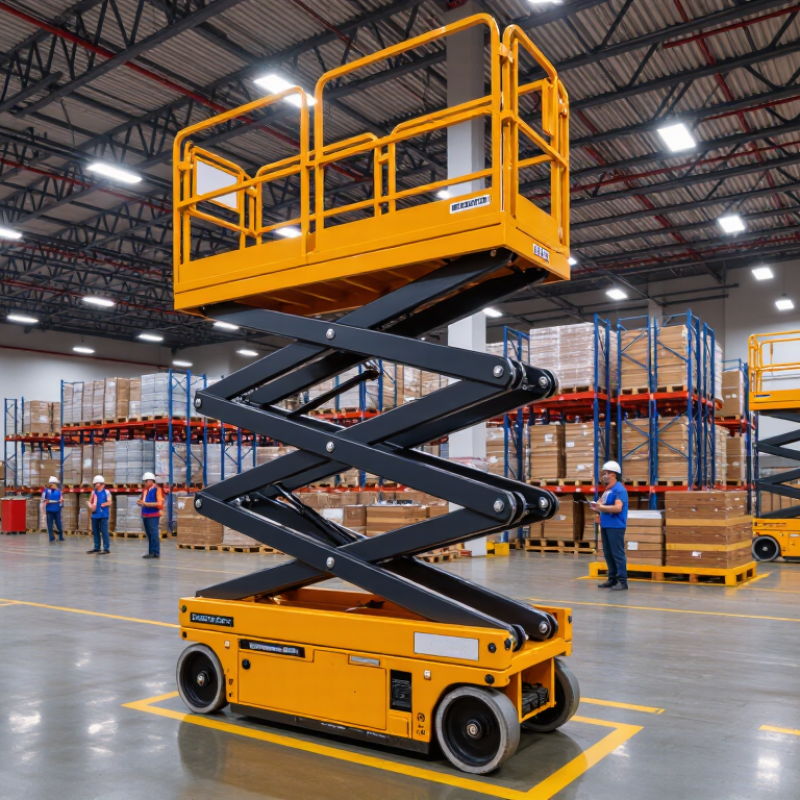
Leading Chinese manufacturers typically offer three scissor-lift families: compact electric models for indoor floors, larger electric units for warehouses, and rough-terrain machines for outdoor sites. Electric lifts suit quiet, low-emission work on smooth concrete. Diesel or hybrid versions add traction and ground clearance for uneven construction sites.
Fit matters. Check platform height, rated load, stowed dimensions, and doorway width against the actual job—not just the product sheet.
Technology now shapes these differences. Common features include proportional controls, tilt alarms, overload sensors, emergency lowering, and pothole protection. Telematics can report battery condition, operating hours, and fault codes; lithium-ion options may reduce charging interruptions, though service access and replacement costs still deserve scrutiny.
Grand View Research estimated the global aerial work platform market at USD 11.6 billion in 2023 and projected a 6.6% compound annual growth rate from 2024 to 2030. That category includes more than scissor lifts, so the figure signals broader demand, not scissor-lift sales alone.
For buyers, compare indoor turning space, battery runtime under real load, tire type, and local parts availability. Spec sheets do not reveal everything. A lift that reaches the target height may still be awkward to maneuver through a narrow aisle.
How Chinese Scissor Lift Manufacturers Compare in the Market
Chinese scissor lift manufacturers compete on more than purchase price. Buyers usually compare platform capacity, working height, folded dimensions, and power options against the actual job site. A lift used in narrow warehouse aisles may need non-marking tires and a tight turning radius. Outdoor maintenance can call for rough-terrain tires, stronger guarding, and weather-resistant electrical connections. Small details matter.
Manufacturers vary in production scale, customization, and quality-control processes. Ask how each model is tested, and request clear specifications, inspection records, and operating manuals. A polished brochure is not proof of consistent build quality. Where possible, inspect a sample unit or arrange an independent pre-shipment inspection. This comparison is rarely as tidy as a price table.
Service support also separates suppliers. Check whether replacement parts are identified by clear part numbers, how quickly common components can be shipped, and whether remote troubleshooting is available. Ask for realistic delivery times, warranty terms, and training materials before placing an order. A lower quote may lose its appeal if a controller or charger is difficult to replace. Some answers may remain vague; treat that as a reason to ask more, not as reassurance.
 Skip to content